 Instagram
 Advert enquiry


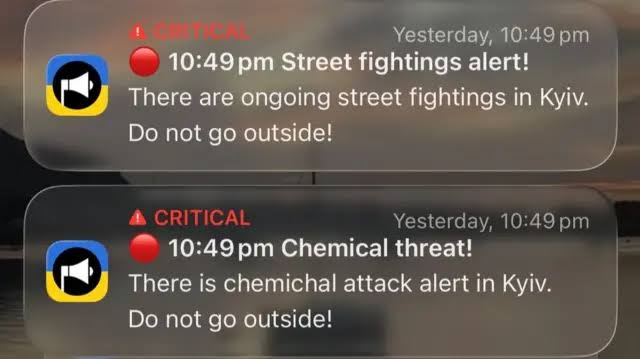
Emergency warning mobile applications in Russia and Ukraine were targeted in simultaneous cyberattacks overnight into Monday, November 2, resulting in the dissemination of false alerts warning of imminent nuclear strikes and chemical threats.
Instead, war-weary citizens predominantly responded with skepticism and a wave of satirical online memes.

Breach of Ukraine’s Air Raid SystemIn Ukraine, the unauthorized notifications were pushed late Sunday through the country's public air raid app, claiming that Kyiv and surrounding regions were facing nuclear strikes, chemical hazards, street combat, and the deployment of Russia’s hypersonic Oreshnik missile.
The system had recently been updated to provide real-time tracking of incoming enemy drones. The Ukrainian Air Force quickly issued a clarification via Telegram, urging the public to remain calm.
“The air alert app appears to have been subjected to enemy influence,” the Ukrainian Air Force stated. “There is no radiation threat! Stay calm and follow our updates on our channel!” Stepan Tanasiychuk, head of Ukraine’s Air Raid Alert project, confirmed on Monday that technicians were progressively restoring operations, implementing new yellow and red alert level maps while bolstering security protocols to prevent future breaches.
Simultaneously, the Russian Ministry of Emergency Situations (Emercom) reported a "massive cyberattack" on its official mobile application early Monday morning. State news agency TASS reported that the compromise sent fabricated emergency notifications to users across 33 Russian regions.
The false message claimed that nuclear warheads had been launched across all regions of Russia.
The ministry later announced that specialists had isolated the vulnerability and restored full functionality to the application.
Officials downplayed the operational impact, noting that primary civil defense warnings rely on municipal sirens, media broadcasts, and SMS networks rather than mobile apps alone.
Addressing the incident, Kremlin spokesman Dmitry Peskov noted that state digital infrastructure remains under continuous cyber pressure.
“All electronic resources belonging to our government agencies are under constant threat of cyberattacks,” Peskov said.
“As technologies, including AI, continue to evolve, the threat of cyberattacks is growing.”
Despite the severity of the fake warnings, public response on both sides of the border leaned heavily toward cynicism and humor.
Social media users in Russia openly questioned how state emergency platforms could suffer such security lapses, with several users expressing frustration over compromised trust.
Meanwhile, Ukrainian users online turned the absurd street-combat alerts into viral jokes, mocking the threat descriptions while continuing to rely on official defense channels for accurate security updates.
















No comments yet. Be the first to share your thoughts.