 Instagram
 Advert enquiry



Political economist Pat Utomi has called for a better standard of living for Nigerians after Finance Minister Taiwo Oyedele said a government survey showed that some poor households spend as much as 120 per cent of their income on food. Oyedele made the remark during an engagement at Chatham House in London, where he discussed the cost of living and the importance of reliable data in policymaking.
The minister was responding to a question about the Federal Government’s investment in data to understand how its policies affect underserved communities. In a video of the engagement shared on his X page on Sunday, Oyedele said the survey was conducted under the current administration, although he did not state when it was carried out.
He contrasted food spending among poorer households with what he described as the experience of middle-class and wealthy Nigerians. “For the poor people, that is 100 percent. In fact, there was a survey we did that shows that up to 120 percent of household income is spent on food,” he said.
Questioning how households could spend more than their income, Oyedele suggested that some might have to borrow food before the end of the month. Spending above 100 per cent of income can be possible when households rely on borrowing, savings or other sources of support. The survey details were not provided in the report.
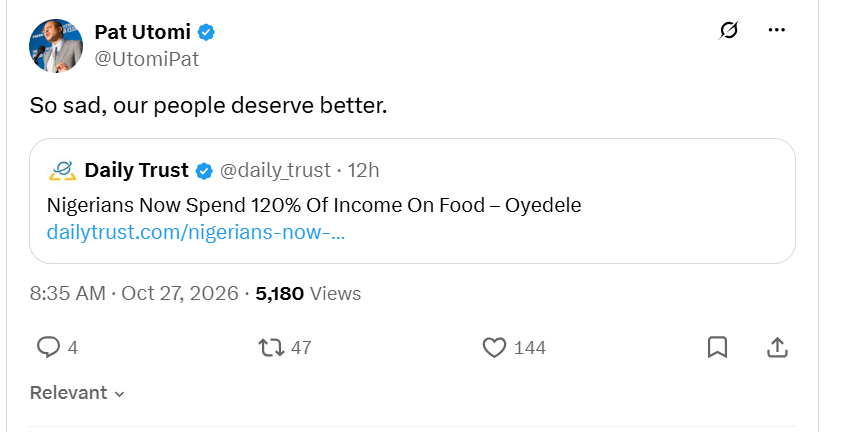
Reacting to the minister’s comments in a post on X on Tuesday, October 27, Utomi wrote: “So sad, our people deserve better.”
During the Chatham House engagement, Oyedele also stressed the importance of credible data in designing policies that reflect the circumstances facing Nigerians.
“If data is missing, or credible data is not at the table, you are not doing policy; you are having a communion,” he said. The minister said the National Bureau of Statistics, which conducts living standards surveys and produces the Multidimensional Poverty Index, had struggled to obtain funding for surveys needed to guide government decisions. He said he became interested in the bureau’s work shortly after assuming office because he relied heavily on its data.
“I called them, and one of the things they told me was that they were not being funded. They struggle to find the money to conduct the surveys we need,” he said. Oyedele cited inflation as an example of a problem that requires detailed data to understand both rising prices and their underlying causes. He said the Consumer Price Index provides information about price levels but does not fully explain why prices are increasing.
The minister noted that some countries also use the Producer Price Index to assess how much inflation is driven by production costs. He argued that such information could help policymakers avoid repeatedly raising interest rates in ways that might worsen existing economic challenges.
Oyedele said he was encouraged by the Central Bank of Nigeria’s move from monetary targeting towards inflation targeting. He added that the CBN and the finance ministry were working together to tackle inflation and better understand its effects on underserved communities. “We are working on it, we are not there yet. But you will see as we roll out the data and use it for decision making,” he said.
The minister also argued that Nigeria’s relatively low unemployment rate did not capture the extent of poverty among people who are working. He put the unemployment rate at about five per cent and said the poverty rate was above 50 per cent, arguing that policymakers should consider both figures when assessing economic conditions.
“You have the working poor. You know, it is even worse when you are working and you are poor,” he said. Oyedele argued that having work does not necessarily mean a person earns enough to escape poverty, and that the condition of working Nigerians should remain part of the policy discussion.









No comments yet. Be the first to share your thoughts.